FIMRO Education Officer pilot project
Tim Merrick @ Focal Plane Photo
Earlier in the year, FIMRO received funding from the Fauna and Flora Community Support Fund grant to run a pilot project to test whether a part-time, community-based seasonal Education Officer post could support long-term, community-led monitoring within the Fair Isle DR MPA project.
The aim of this project was to sub-contract an island resident with relevant experience to work closely with the DR MPA Research Officer who lives off island to plan and facilitate community and visitor engagement and participation in priority citizen science and marine monitoring activities outlined by FIMRO.
At the start of the project FIMRO advertised this role within the community and confirmed interest in this potential among island residents. David Parnaby an island resident, was selected to fill the role. Across June – September 2025 David delivered 135 hours of work, including training, administration, public events, citizen science coordination, and data processing. Marine monitoring/citizen science activities included WDC Shorewatch surveys, Marine Conservation Society (MCS) beach cleans, marine invasive species checks, and informal outreach. WDC Shorewatch became the most time-intensive activity, achieving—for the first time—the national target of 20 watches per month at both Fair Isle sites (Buness and South Lighthouse) during the summer. Five Fair Isle residents were recruited and trained as Shorewatch volunteers, which, including the Education Officer, represents 10% of the entire Isle population building a strong community base for future monitoring. As well as two training days, a public event was held with Karen Hall of NatureScot, during which a number of watches were carried out by various participants.
A new monitoring activity trialled during this project was beach cleans following MCS methodology, where a 100m stretch of beach is cleaned, with all items of litter that are removed being identified, categorised and recorded. Over the course of the project seven beach cleans were carried out across three beaches: Noth Haven, Leestit and Muckle Uri Geo. North Haven and Leestit were cleaned again in September as part of the Great British Beach Clean, a week long UK-wide citizen science event with Muckle Uri Geo being cleaned by the Fair Isle Primary School coordinated by the FIBO ranger with support from the Education Officer. This beach has now been adopted by the FIPS for quarterly beach cleans.
Over the course of the project, beach cleans involved an average of 7 participants per event (many returning), with the highest number of participants up to 18 at one beach clean. Across all beach cleans, 70.8 kg of litter was removed consisting of 2519 individual pieces the majority (87%) being plastic. Leestit produced the most litter by a considerable amount.
At the end of the project, David produced a summary report identifying the key successes and challenges of the project, recommendations from which will be reviewed by FIRMO in the New Year to further develop the project for consideration in the future. Overall, the pilot suggests that a seasonal Education Officer is feasible and valuable and can meaningfully strengthen community engagement and contribute useful long-term datasets for Fair Isle’s marine environment.
Thank you very much to David for his work and efforts on this project and to everyone who got involved.
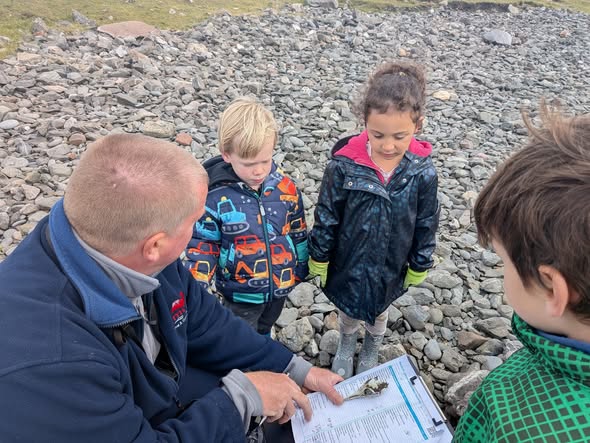
FIMRO Education Officer David Parnaby working with the Fair Isle Primary School

Marine Conservation Society Beach Clean at Leestit
We gratefully acknowledge the significant impact this funding has had on the development of the DR MPA and the work FIMRO is able to undertake.